
 Flights
 Hotels
 Holidays

EXTRA REWARDS AT PAYMENT
One trip. Two ways to save.
Use an eligible FlyXworld coupon, then check available card, bank or wallet rewards at payment. No bank offer is confirmed until eligibility is checked.
City & Intercity Bus Travel —
Easy journeys start here
Book your bus seat in a few taps. Check live timings and fares on your route, pick a boarding point that suits you, and choose the exact seat you want before you pay.
FlyXworld sells bus tickets for routes inside India, and you can book them before you fly. If you're landing in Delhi and heading to Jaipur or the hills, or travelling down the coast from Mumbai to Goa, this is where you book the road part of the trip. Bus services outside India, including buses to Nepal, aren't on FlyXworld.
Indian intercity buses are run by many private operators, and the same route can have a dozen buses a night with very different seats and prices. A good booking comes down to where you get on, what kind of seat you're in, and when you arrive.
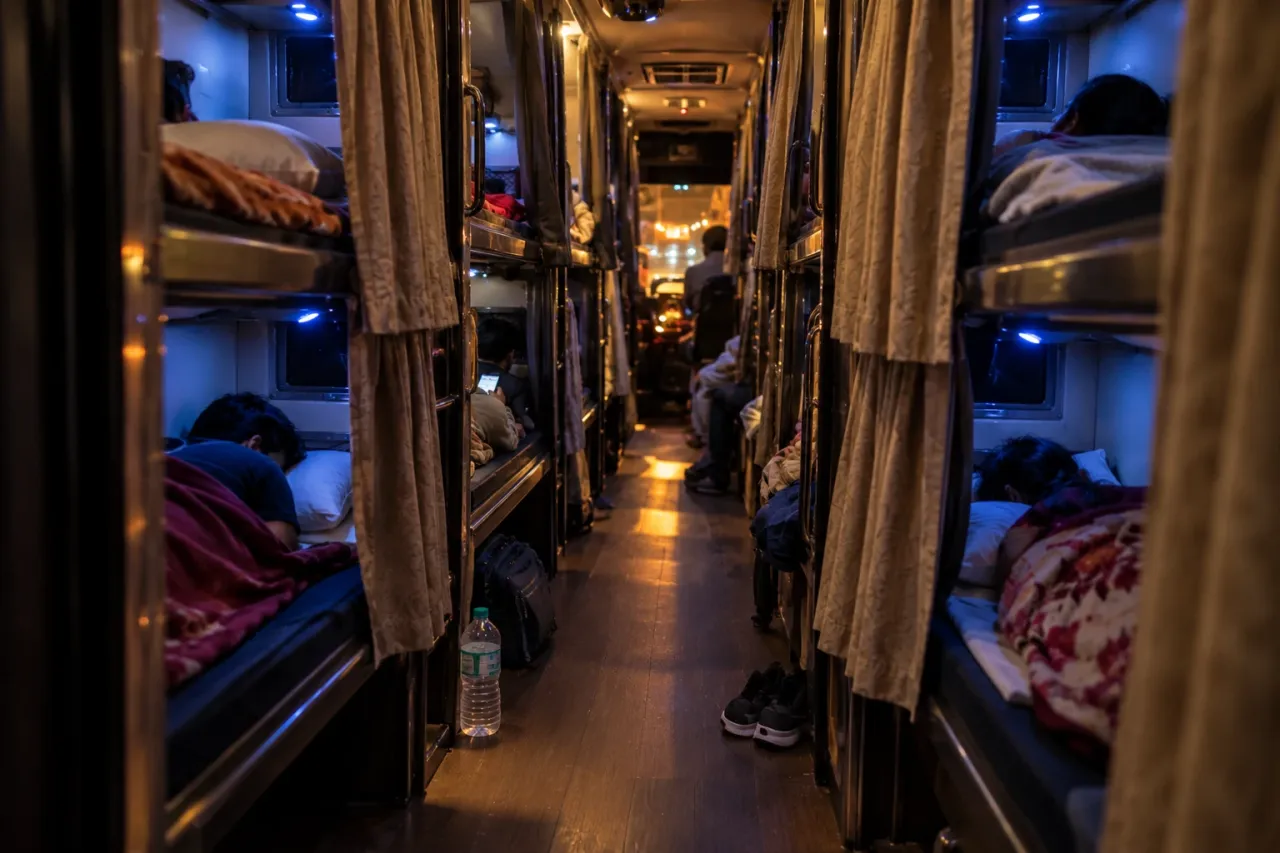
Lower berths are easier to get in and out of. Upper berths are usually a bit quieter.
Pick your departure city and destination from the suggestions, choose the date and search. Each result shows the operator, bus type, departure and arrival times and the fare. Open the seat map on the bus you like, choose your seats, then pick the boarding point and the drop point.
Fill in the passenger names and a phone number that will work in India on the day, because the operator or driver may call or message it. If you're using a phone from abroad, make sure it can receive calls in India. Check everything once more and pay. Your ticket comes through once the operator confirms it.
You don't need a bus booking app for this. The FlyXworld website works on a phone, and the FlyXworld app on Android has bus search too. Keep the ticket saved on your phone in case mobile data is weak at the pickup point.
Buses link almost every city in India, and for many trips they're cheaper than flying and easier to book than a train at short notice. Overnight buses save you a night's hotel and get you there by morning.
The trade-off is road conditions and traffic, so arrival times are estimates. Leave a buffer before anything time-critical, like a flight or a tour start.
A sleeper bus has two decks of berths along each side of a narrow aisle. Each berth has a mattress and a curtain, and many have a reading light and a charging point, though that varies by operator. Single berths are for one person. Double berths are shared, so book both halves if you're travelling with someone or don't want a stranger next to you.
Most sleeper buses don't have a toilet on board. They stop at roadside restaurants every few hours, so ask the staff when the next stop is if you need it.
Volvo buses in India are usually AC seaters or sleepers on multi-axle coaches, and they're smoother and quieter on long roads. Check the bus type on each result, because a photo of a big coach doesn't confirm the make. A Volvo seater reclines but doesn't go flat, so for a full night, a sleeper berth is more comfortable.
The Delhi to Agra bus takes around 4 hours on the expressway, and day buses are the easiest way to see the Taj Mahal from Delhi. Remember the Taj Mahal is closed on Fridays.
The Delhi to Jaipur bus takes around 5 to 6 hours, so a daytime Volvo or AC seater works well. Together with Agra, it makes up the Golden Triangle that many first-time visitors travel by road.
The Delhi to Rishikesh bus takes around 6 to 7 hours, often overnight, and many buses stop in Haridwar on the way.
The Delhi to Manali bus is an overnight trip of roughly 12 to 14 hours, longer in bad weather. Volvo and AC sleeper buses are the usual choice. The last part climbs through the hills, so if you get travel sick, a lower berth near the front helps. Pack a warm layer in winter.
The Mumbai to Goa bus is an overnight trip of roughly 12 to 14 hours. Many buses drop at several points in Goa, so pick the one closest to where you're staying.
The Goa to Hampi bus runs overnight and arrives in the early morning. Check the drop point, since some buses stop in Hospet, a short ride from Hampi.
The Bangalore to Mysore bus takes around 3 to 4 hours, with frequent departures through the day.
The Delhi to Shimla bus takes around 8 to 10 hours, and the Delhi to Dharamshala bus, for McLeod Ganj, is an overnight run of roughly 10 to 12 hours. Both climb into the hills for the last few hours, so pack a warm layer.
In Rajasthan, the Jaipur to Udaipur bus takes around 7 to 8 hours and the Jaipur to Jodhpur bus around 5 to 6. Day buses let you see the countryside, while night buses save a hotel night.
In the south, the Bangalore to Ooty bus takes around 7 to 8 hours, with the last part on hill roads, and the Chennai to Pondicherry bus takes around 3 to 4 hours along the coast. The Mumbai to Pune bus takes around 3 to 4 hours on the expressway.
These times are a guide. The arrival time on each bus is the operator's estimate for your date, and traffic in and out of big cities can add an hour or more.
Most operators allow one or two pieces of luggage per passenger in the compartment under the bus, plus a small bag with you. Each operator sets its own limit, so ask the staff at boarding if you have a large suitcase or a backpack frame. Keep your passport, money, medicines and charger in the bag you keep with you, and lock the bag that goes underneath.
Long-distance buses stop at roadside restaurants every few hours for food and toilets. The stops are usually short, so ask the staff how long you have and note the bus number before you get off. Carry water and a snack in case the bus doesn't stop when you're hungry.
Solo travellers, including women, use India's intercity buses all the time. Seats reserved for women are marked on the seat map where the operator has them, and a berth near the front, close to the driver's cabin, is a common choice. Share your ticket and the bus number with someone, save the operator's phone number before you board, and arrange your pickup at the other end before an early-morning arrival.
Indian trains are a great way to travel, but booking them from abroad takes more steps, and popular trains fill weeks ahead. Buses are easier to book at short notice, run on routes the trains don't serve well, and an overnight bus can save a hotel night. For very long distances, a flight or train is usually more comfortable than more than one night on a bus.
Buses fill early and fares rise around Diwali, Holi and long weekends, and around big regional festivals like Durga Puja in the east and Pongal in the south. If your trip falls on those dates, book as soon as your plans are fixed.
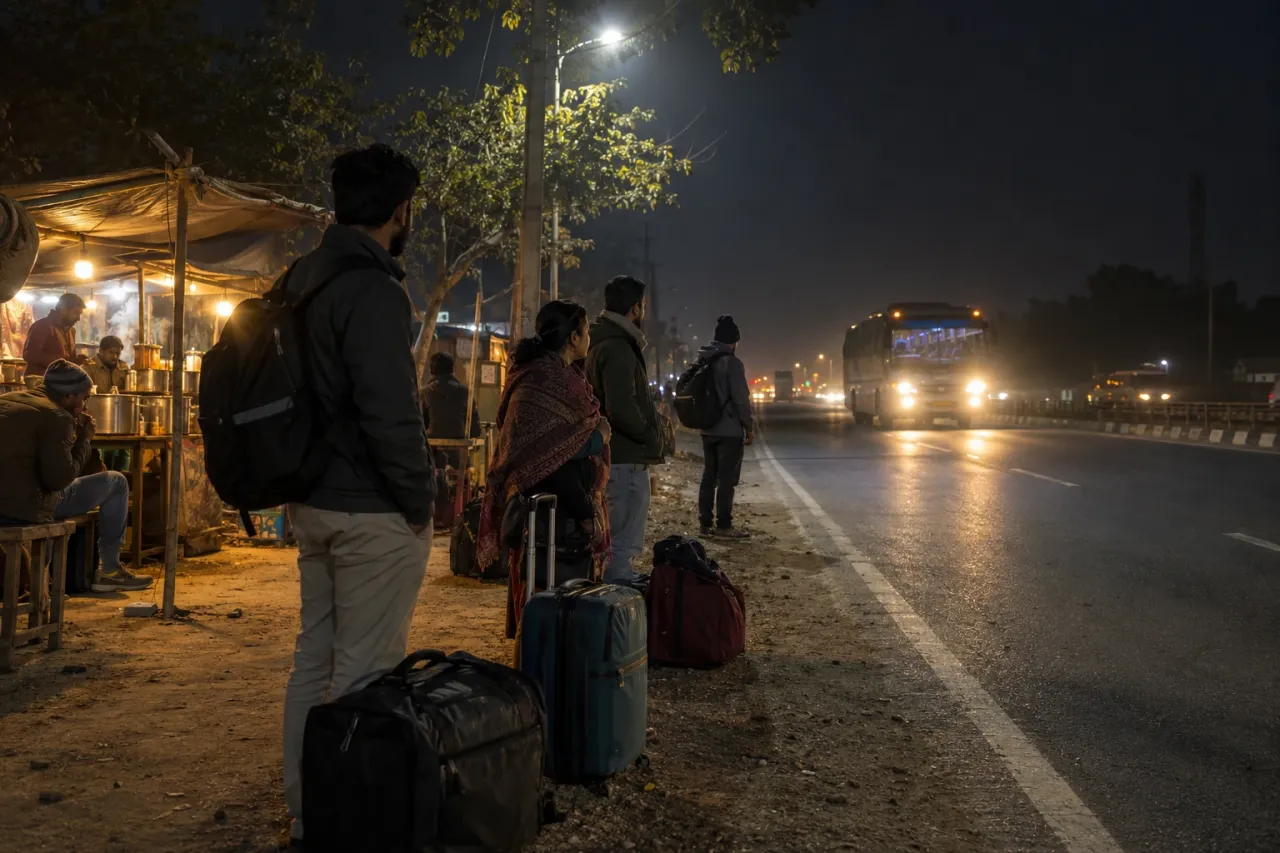
Pickup points are often by the roadside. Arrive by the reporting time on your ticket.
Each result names the bus type, and it's worth reading in full:
Overnight buses often arrive between 4 and 6 a.m. Hotel check-in is usually around noon, so ask your hotel about early check-in or book the room from the night before. Have your onward ride sorted before you arrive, since the drop point may be on a highway rather than in the centre.
Big Indian cities have many pickup points for the same bus, often along a main road rather than at a bus station. Your ticket shows the exact point and a reporting time, which is a little before departure. Look it up on a map before you choose the bus. A cheap seat that boards an hour across town costs more once you've paid for the taxi.
The same goes for the drop point. A bus that arrives at 4 a.m. at the edge of a city can leave you waiting a while for a hotel check-in or a ride.
If you're catching a bus after an international flight, leave a generous gap for immigration, bags and getting across the city. Flights run late, and a missed bus usually can't be refunded.
A bus that leaves at 00:30 on the 12th leaves just after the night of the 11th. If you turn up on the evening of the 12th, you've missed it by almost a day. It's the most common mistake with overnight buses, so check the date and time on the ticket twice.
Most sleeper buses in India are run by private operators, and the cheapest sleeper bus on a route is usually a non-AC sleeper. AC sleepers and lower berths cost a little more. Bus ticket prices in India depend on the bus type, the seat, the day and how close to departure you book. Search your date to see the current fares. A non-AC seater and an AC sleeper on the same route are very different nights, so compare the seat type and timing along with the price.
Cancellation rules are set by each operator and usually get stricter close to departure. Read them on the bus before you pay.
Yes. Search your route and date on FlyXworld, choose your seats and pay online. Give a phone number that will work in India on the day of travel.
No. FlyXworld bus booking covers routes within India only.
Most don't. They stop at roadside restaurants every few hours. Ask the bus staff about the next stop.
Usually one or two pieces under the bus plus a small bag with you, but each operator sets its own limit. Ask at boarding if your bag is large.
Yes. Open the seat map for the bus you want and pick from the seats shown as available. The seat is yours once the ticket is issued.
A bus ticket is separate from your flight, so it won't move if the flight is delayed. Leave plenty of time between landing and departure, and contact the operator or support as soon as you know you'll be late.

Try on mobile
Get the FlyXworld app
Live flight fares, instant e-tickets and trip updates, right on your phone.
